Decide what governance architecture should exist before committing to enterprise tooling.
01 · Flagship Case Study · Runnymede
AI governanceas a decision system.
Runnymede is a vendor-neutral, pre-platform AI Governance Readiness Decision Engine that turns organizational context, AI use-case context, evidence, risk and controls into governed executive decisions and an executable path forward.
AI assists · Python decides · Evidence explains · Humans approve.
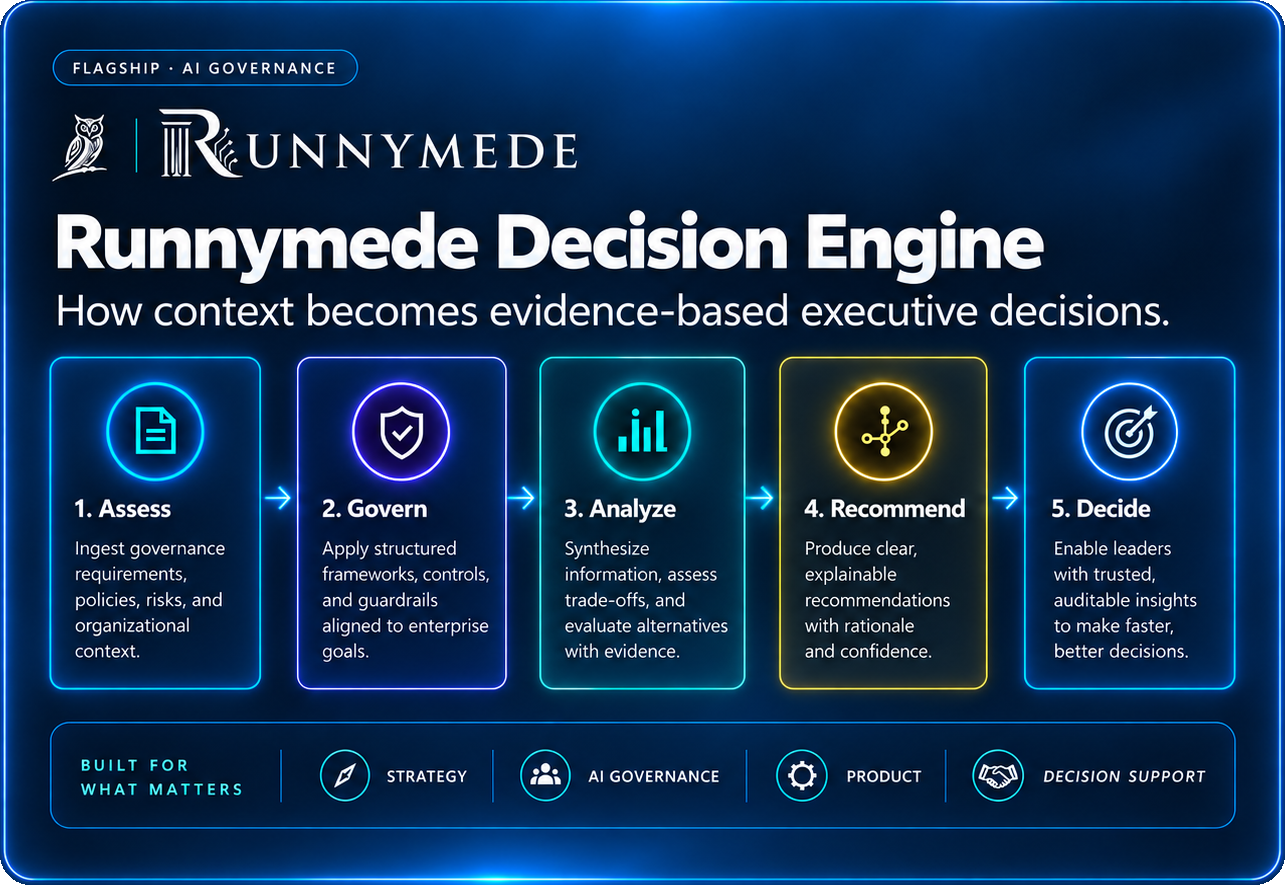
Published baseline with readiness, evidence maturity, risk, controls and executive outputs.
Official scores, risk classifications and control rules remain authoritative; material decisions remain human.
A complete decision chain, not an isolated maturity questionnaire or generic chatbot.
01 · Executive challenge
Governance architecture before governance tooling.
The strategic problem sits upstream of platform selection: organizations can invest in AI governance technology before they know which controls, evidence, accountabilities and operating model they actually need.
The problem to solve
AI ambition creates pressure to move quickly, but governance decisions are often fragmented across policy, risk, legal, security, data and business teams. Tooling can then become a substitute for clarity rather than an enabler of it.
Runnymede was conceived as a neutral decision layer that establishes readiness, risk, evidence, controls, ownership and the platform path before scale. The objective is not simply to assess whether an AI system works; it is to determine whether the organization is prepared to exercise legitimate governance over that system.
AI ambition→Fragmented governance→Premature tooling decisions
Runnymede · upstream decision layerReadiness · Risk · Evidence · Controls · Ownership → Platform path
What must exist before scale?
Capabilities, controls, owners, evidence and approval rights must be explicit before enterprise tooling becomes the answer.
Vendor-neutral and upstream
Recommend no platform, workflow-first, data-first, GRC-first, MLOps-first, security-first or agentic-controls-first paths based on the evidence.
Turn ambiguity into governed execution
Make the decision system understandable, traceable and actionable for executives without diluting governance rigor.
02 · The Runnymede foundation
From human authorityto measurable governance.
The brand doctrine is not decorative positioning. It defines the values and principles that the product must translate into controls, evidence, decision rights and operating rules.
Vision : the future we seek
To inspire every organization to govern AI responsibly, ensuring that artificial intelligence remains accountable, fair, transparent, and ultimately subject to human authority.
Mission : what we do
To empower organizations to govern AI with confidence by turning accountability, fairness, transparency, and human sovereignty into measurable governance, evidence-based controls, and responsible decisions throughout the AI lifecycle.
Accountability
AI power must always be accountable.
Fairness
AI must be governed and used with fairness and proportionality.
Transparency
AI authority and its governance must be understandable and traceable.
Human Sovereignty
Ultimate authority over AI remains human.
03 · From doctrine to decision system
Principles become controls. Controls become evidence. Evidence enables decisions.
This chain is the conceptual bridge between Runnymede's institutional foundation and the actual product logic.
What matters
Accountability · Fairness · Transparency · Human Sovereignty.
How authority is bounded
Seven rules governing legitimate AI authority and human oversight.
How governance operates
Policies · ownership · approvals · oversight · safeguards · monitoring.
What proves it
Demonstration that required controls are present, current and operating.
What should happen next
Proceed · controlled pilot · governance required · platform path · stop/redesign.
Assess. Evidence. Govern. Decide.
The product operationalizes the doctrine as a repeatable decision system.
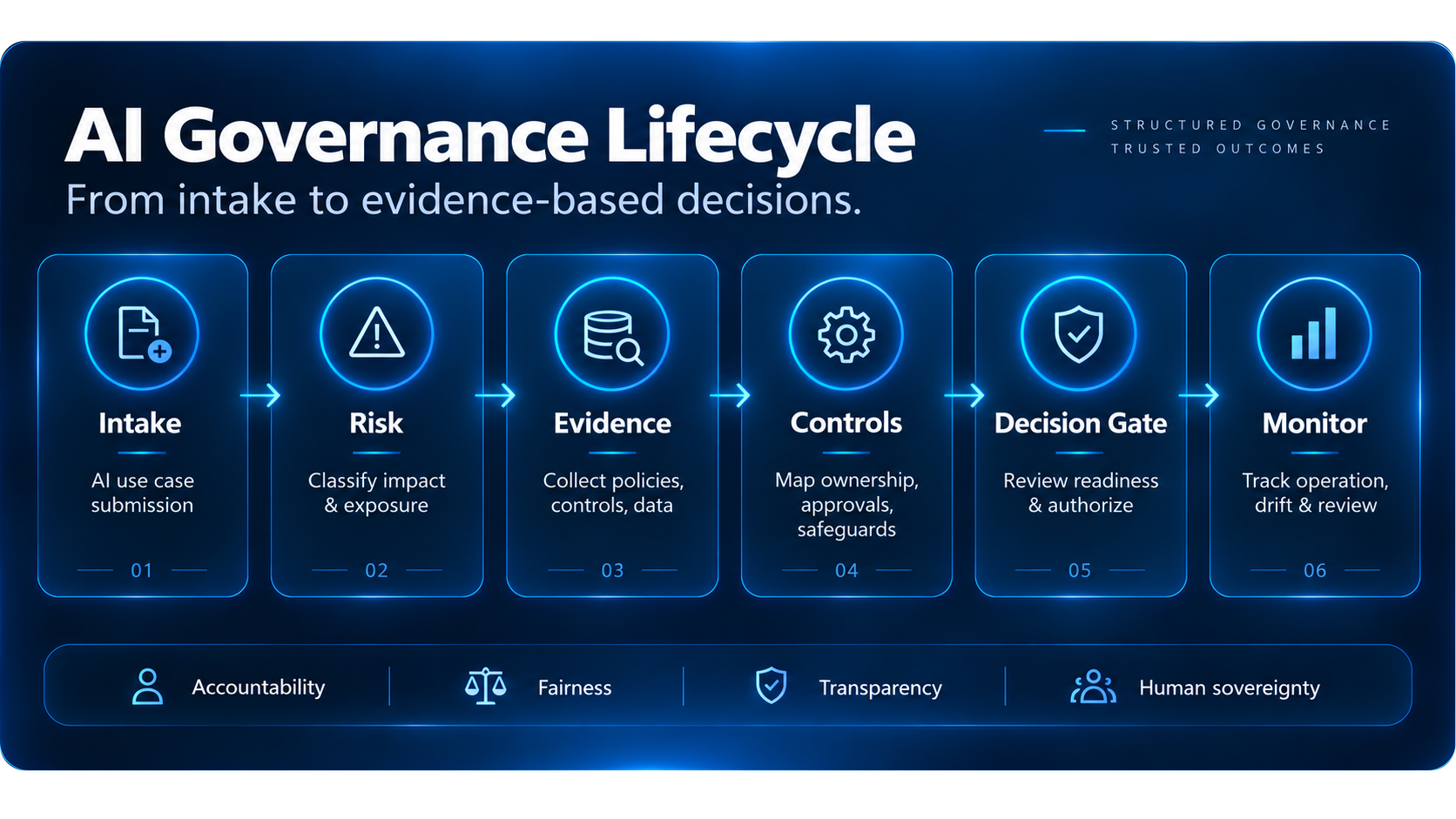
04 · Product decision engine
A full governance decision chain.
The differentiator is the end-to-end workflow: context and ambition are converted into readiness, evidence maturity, risk, controls, operating-model requirements, a platform path and a board-ready execution plan.
01
Context & AI ambition
Organization, sector, exposure, use case, data and autonomy.
02
Readiness diagnosis
Deterministic and explainable assessment of governance preparedness.
03
Evidence maturity
Evidence Maturity Score across seven dimensions; claim and proof remain distinct.
04
Risk classification
Regulatory, operational, security and accountability exposure.
05
Controls & gaps
Required versus present controls, evidence gaps and remediation priorities.
06
Agentic readiness gate
Permissions, logging, rollback and explicit autonomy constraints where relevant.
07
Platform path
No platform, workflow, data, GRC, MLOps, security or agentic-controls-first recommendation.
08
Evidence Pack & roadmap
Board-ready decision record with a 30 / 60 / 90 remediation and execution plan.
Governance ruleDeterministic scoring, evidence maturity, risk classification and control mapping remain authoritative. Evidence gaps trigger remediation; material governance decisions remain human.
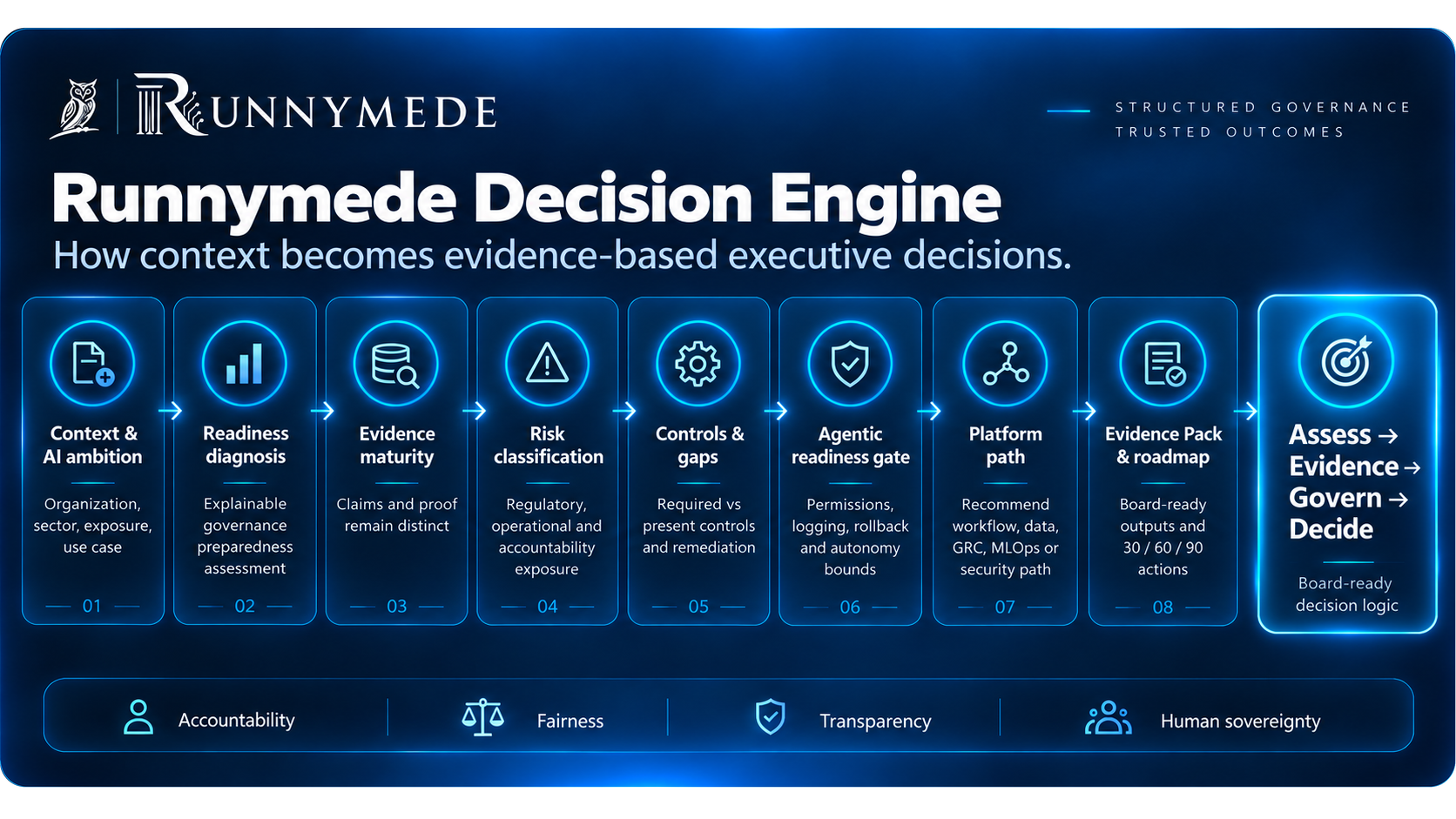
05 · Governance operating model
Who decides. Who owns. What evidence proves it.
Runnymede does not stop at maturity scoring. The operating model turns the assessment into decision rights, ownership, approval gates, evidence requirements, escalation rules and remediation cadence.
Intake
Risk
Evidence
Controls
Decision Gate
Monitor
Gate policy: a gate opens only when required evidence exists, accountable owners are assigned, control gaps are accepted or remediated, and human approval is recorded for material decisions. Continuous reassessment is triggered by new use cases, regulation changes, incidents, vendor changes or material model updates.
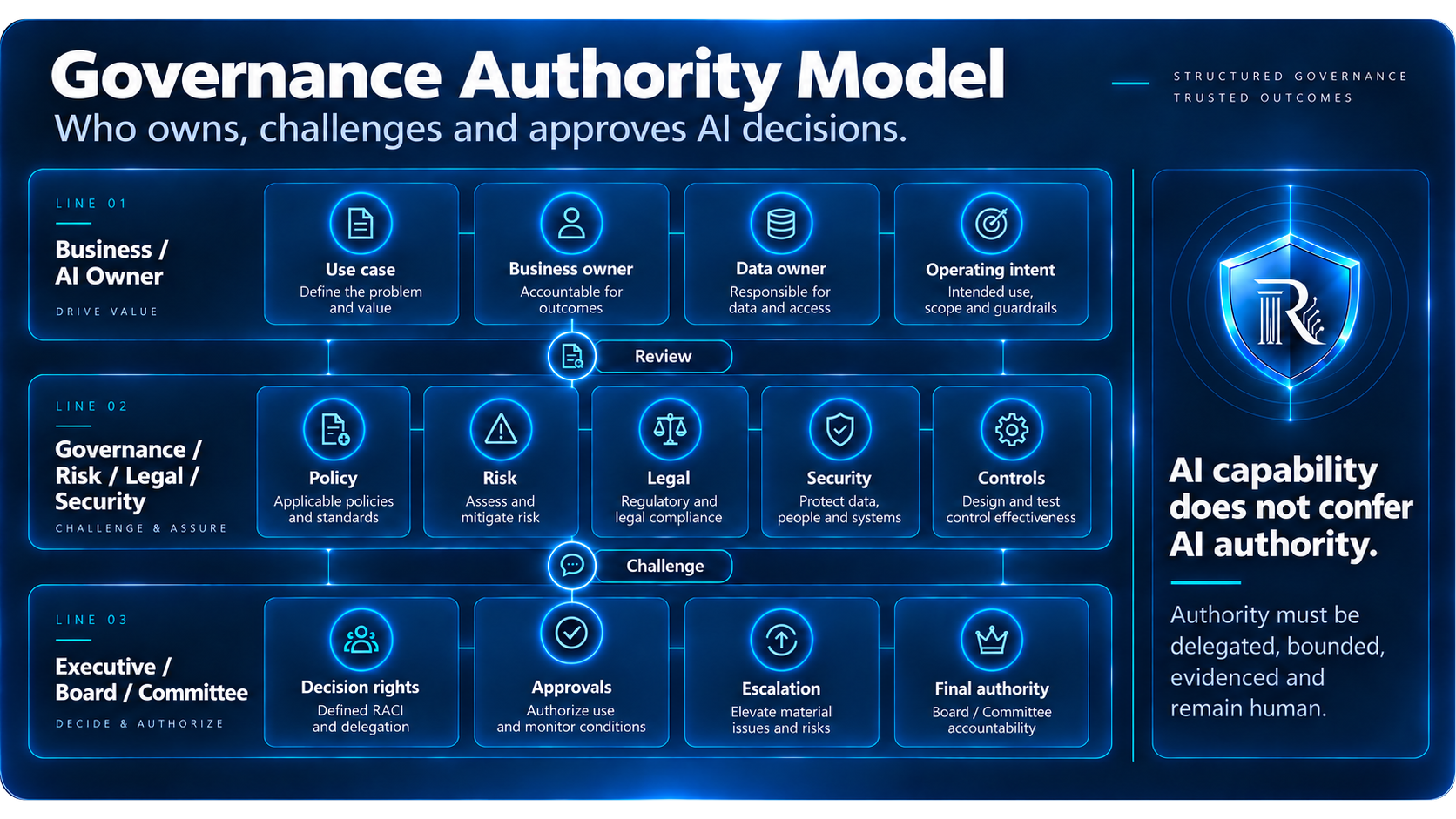
06 · Key executive & product decisions
What had to be decided : not just built.
The case demonstrates product judgement and governance design choices that constrain the architecture and protect decision quality as the platform evolves.
01
Position upstream of enterprise tooling
Keep Runnymede vendor-neutral so the product can decide whether tooling is needed now, later or not yet, and which category is appropriate.
DecisionTooling follows governance architecture.
Boundary“No platform yet” remains a valid outcome.
02
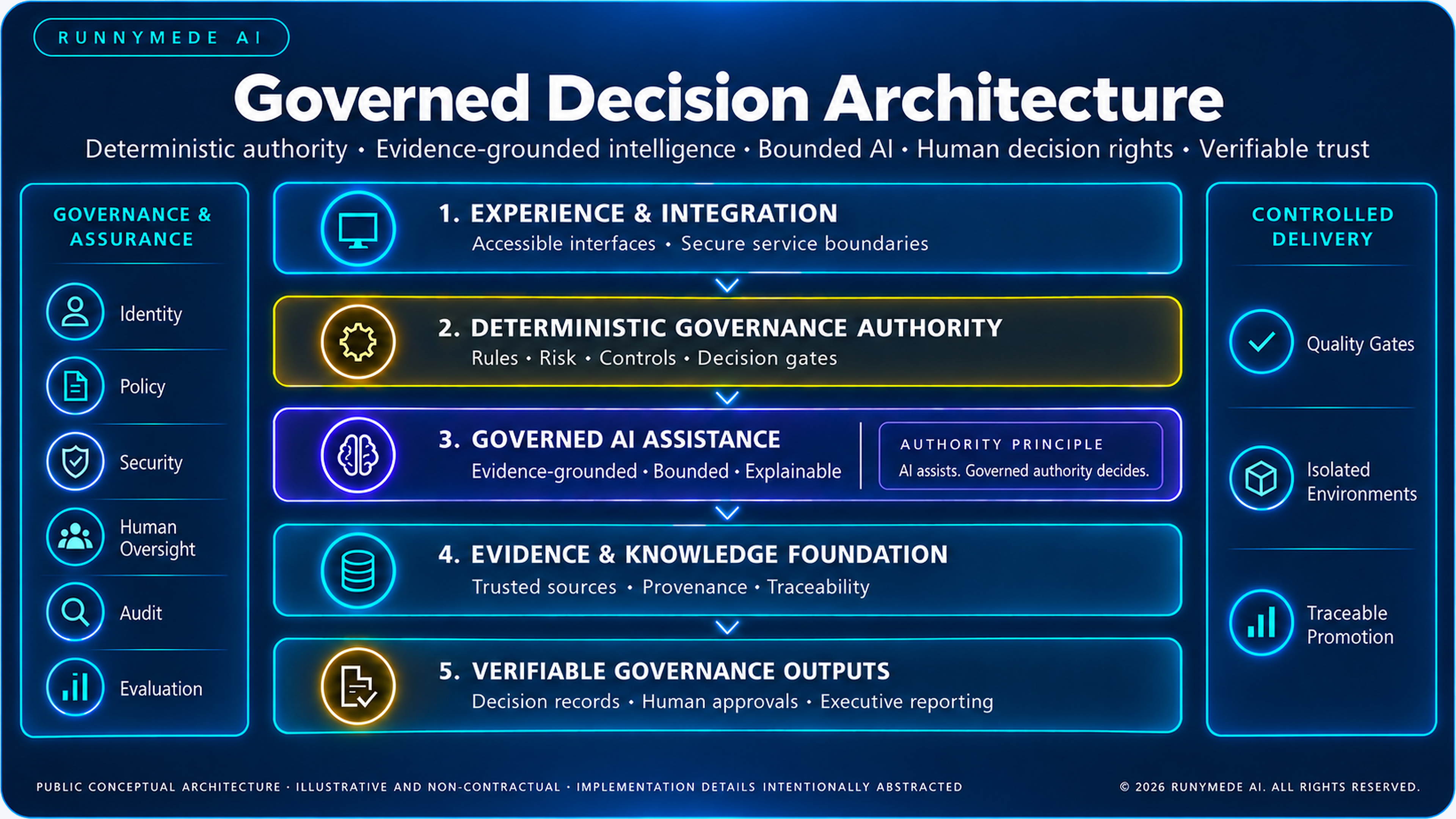
Keep deterministic engines authoritative
Official readiness scores, evidence maturity, risk classifications and control mappings remain rule-based and explainable.
DecisionDeterministic core remains authoritative.
BoundaryAI does not own official scoring or control rules.
03
Preserve human final authority
AI may assist with explanation, retrieval and synthesis; no autonomous agent makes the final governance decision.
DecisionHuman approval remains final.
BoundaryNo autonomous final governance decision.
04
Make evidence a governance backbone
Separate declarations from verified evidence and preserve ownership, freshness, version, source and traceability.
DecisionEvidence is distinct from claims.
BoundaryOwnership · freshness · source · traceability required.
05
Data foundation before agent autonomy
Sequence delivery deliberately: evidence registry and SaaS foundations before RAG, agent harness, MCP and orchestration.
DecisionFoundations precede autonomy.
BoundaryEvidence registry · SaaS · API before agent stack.
06
Govern capabilities, not raw system access
Future agents call allowlisted business capabilities behind policy gates — never unrestricted database or infrastructure commands.
DecisionGovern business capabilities.
BoundaryNo raw database or infrastructure commands.
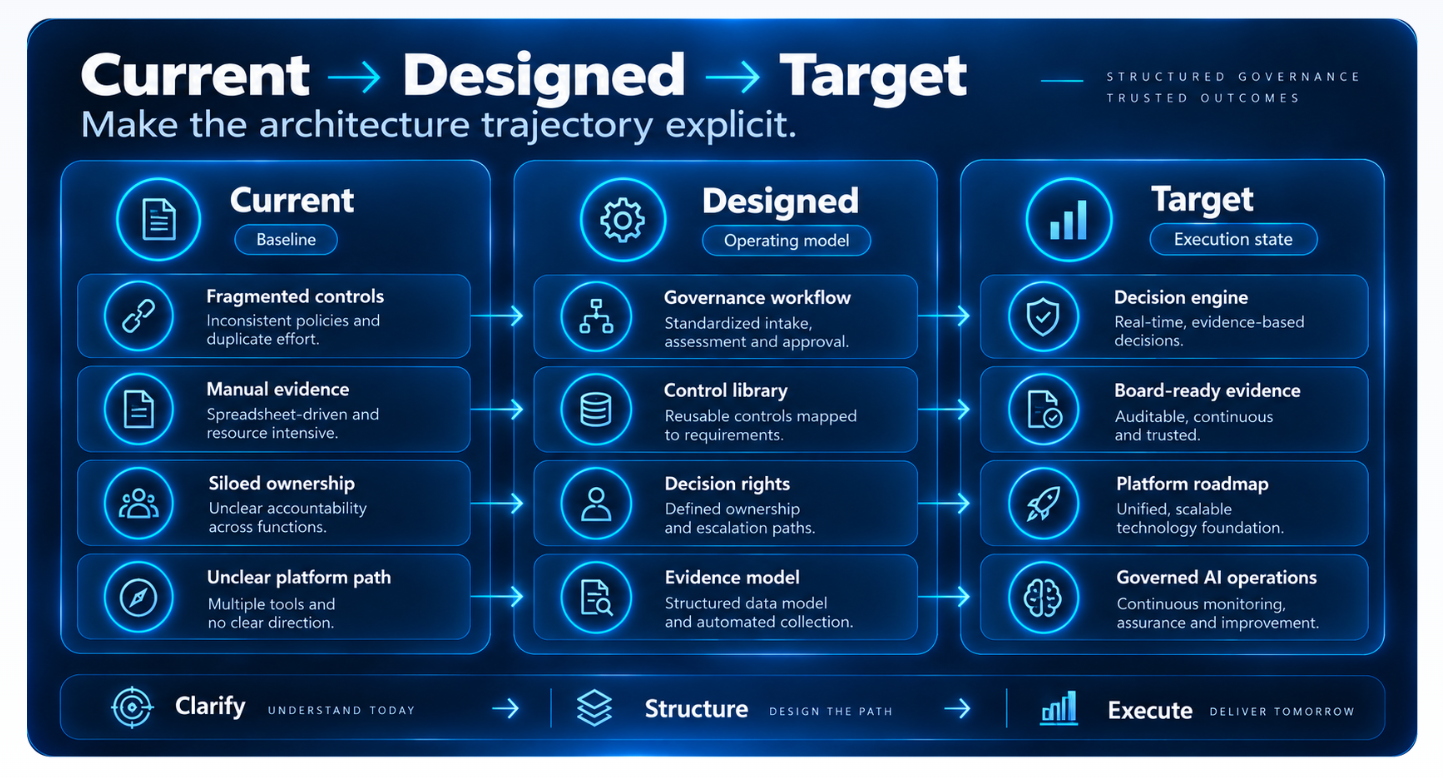
07 · Built today vs designed vs target
Make the architecture trajectory explicit.
The page deliberately separates current product truth from designed next steps and target capabilities. This protects credibility and shows disciplined technology leadership.
Deterministic decision core
Functionally published baseline.
- Readiness diagnosis and deterministic scoring
- Evidence Maturity Score — 7 dimensions
- AI risk classification and risk-based controls
- Agentic readiness / shelfware & platform recommendation
- Markdown / PDF diagnostic and Executive Evidence Pack
- 61 / 61 automated tests PASS
Evidence & SaaS foundation
Documented architecture and operating-model direction, not presented as current production capability.
- V1.3 Evidence Registry & traceability candidate
- Organizations, users, roles and tenant isolation
- FastAPI service boundary and pilot foundations
- PostgreSQL system of record + secure object-storage pattern
- Decision rights, RACI, approval gates and governance pack
Governed AI platform
Roadmap trajectory subject to controlled validation and release gates.
- Governed regulatory and customer-evidence RAG
- Agent Harness with human approvals and evaluations
- MCP governed business capability layer
- Progressive LangGraph orchestration
- Bounded specialist agents and enterprise integrations
Architecture boundary: PostgreSQL, FastAPI, pgvector/RAG, LangGraph, MCP and the target multi-agent runtime are trajectory components. They must not be represented as already implemented in the V1.2.x product line.
08 · Evidence of execution
Proof behind the narrative.
Only evidence supported by the current source material is shown here. Commercial impact metrics are intentionally excluded until independently verified or explicitly user-confirmed.
✓
Published V1.2.0 baseline
A deterministic product baseline covering readiness, evidence maturity, risk, controls, platform recommendation and executive reporting.
61
61 / 61 automated tests PASS
A documented quality signal for the current deterministic baseline.
◎
Governance operating model
Decision rights, RACI, gates, evidence requirements, committees, escalation rules and remediation cadence formalized as a reusable model.
↗
Executable product trajectory
Roadmap sequences evidence registry, SaaS foundation, API, RAG, bounded agents, MCP and orchestration in dependency order.
Evidence governance rule: no revenue, adoption, ROI, compliance or customer-impact figure is published in this case study unless its evidence status is verified or explicitly user-confirmed.
09 · Outcome & leadership value
What this case demonstrates.
Runnymede shows the ability to connect institutional vision, governance doctrine, product strategy, operating-model design, architecture choices and disciplined execution in one coherent decision system.
A governance philosophy converted into an executable system.
The work moves from values and principles into deterministic readiness, evidence, risk and control logic; then into an operating model, board-ready outputs and a sequenced technology roadmap.
Build the governance decision layer before building the governance platform.
Ambition is useful only when authority boundaries remain explicit.
The architecture deliberately distinguishes deterministic authority from AI assistance, current capability from target state, and product acceleration from the human accountability that governance requires.
Assess → Evidence → Govern → Decide.